

By Sara Bucher
Of course a play called Gun Love would follow a circular Chekhovian logic. As the lights come up: the sound of a gun being cocked. Lights off: gunshot. And in between: lots and lots of guns.
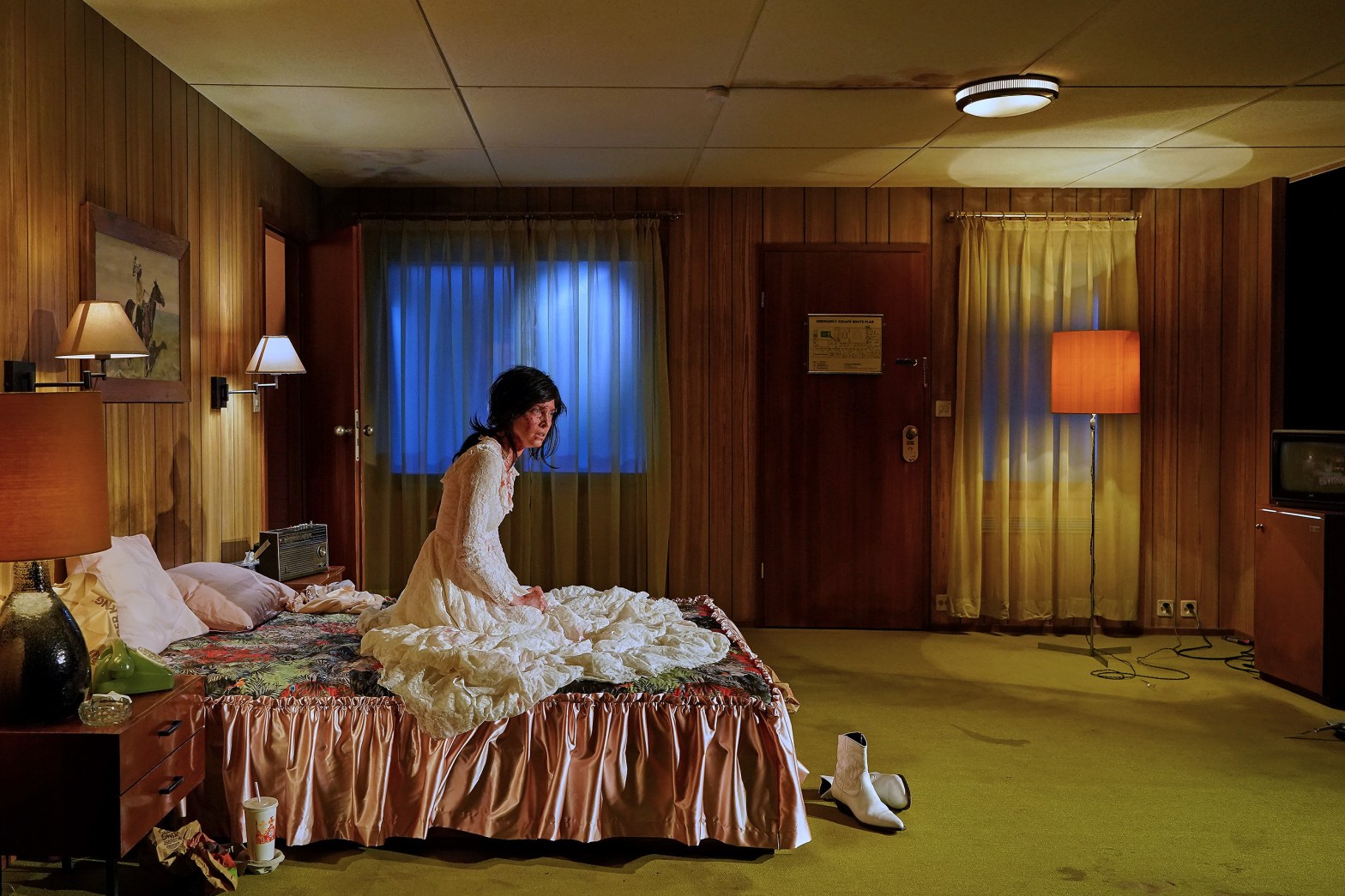
“Memory,” Pearl, the narrator, informs the audience near the beginning, “is the only substitute for love.” And since there does not seem to be a lot of love left in Pearl’s life – all alone as she is in a depressing motel room, covered in Burger King wrappings, wearing a blood-splattered wedding dress – it is memories she has to share: switching between pre-recorded voice-overs and performed monologues, Pearl reminisces about her childhood and, all by herself, plays out a vision that oscillates between childhood whimsy and the dystopically tinged nightmare that is America.

Growing up, Pearl’s America is literally a Floridian garbage dump filled with guns, built on top of a Timucua burial ground. Her mother raised her in a car, she informs the audience, a whole world spanning between her nursery on the front seat and her mother’s valuable possessions – a violin, silverware, delicate china – stored in the trunk. Pearl’s playground is the garbage dump, populated with many distinct characters, all of which she brings to life through her narration: her friend April, a feisty, freckled adventurer who sets Pearl up to steal cigarettes; April’s father, an Afghanistan veteran who suffers from PTSD and gives his wife a gun for Valentine’s Day; Ray and Corazón, a Mexican couple who only smoke Marlboro Reds and store an impressive collection of various firearms in their trailer; Pastor Rex, who advocates drive-through prayer (you don’t even have to switch off your motor or your radio to converse with the creator!) and collects “guns for God”; and finally Eli, who disturbs the intimate mother-daughter-relationship, pushes Pearl from her place in the car – and, naturally following the play’s title, presents her mother with a gun of her own. This gift, of course, yet again makes Chekhov sigh in fateful foreboding.
That Gun Love the play is adapted from Jennifer Clement’s eponymous novel may both be its major strength and its biggest weakness: set in a motel room with Pearl as its only character, the play’s language envelops its audience with lyrical monologues and a sense of poetic wonder – most beautifully complimented by Sandro Tajouri’s score, the two intertwining into a dream-like whole. Lucy Wirth’s strong performance as Pearl, breathing life into the literary monologues, situates her character somewhere between a young child who finds joy in poignantly imitating those around her and a young woman traumatized by the world beyond the seeming security of her motel room. Wirth sighs and whispers and screams and sobs, marches, skips and crawls, swiftly switches between postures and accents, and, by doing so, artfully and energetically brings to life an entire childhood all by herself: the world she creates out of Clement’s words feels rich and vivid.
However, its literary origin might also be the source of the growing sense of fragmentation and disorientation that starts to show especially in the final third: while the play is predominantly interested in stream-of-consciousness introspection, voice, and memory, it does seem to lose quite a bit of narrative cohesion towards the end, leaving the spectator wondering what exactly is going on at times – and perhaps wishing to immediately leaf through Clement’s book to see how she initially chose to narrate the events. It seems sometimes that Gun Love might be more of an immersive audio-visual literary experience than a thoroughly staged play, which also leads to repetitive movement across the set to accompany the ruminant monologues.

And yet, in its most striking moments, Gun Love offers a fascinating and affecting vision of America that feels both shocking and true: a childhood spent on the fringes of society, individuals and societal structures that were and are continuously being formed through violence – and a nation steadily tearing itself apart in its insistence on the Second Amendment.
Director: Tom Schneider
Set Design: Simeon Meier
Costume: Heike M. Goetze
Music: Sandro Tajouri
Dramaturgy: Angela Osthoff
With: Lucy Wirth
Premiere: Sa 16. March, 8 p.m.
Please visit Theater Neumarkt for more information on the play and ticket reservations.


Thank you for reviewing the premiere! We still show GUN LOVE in March, April and May.
LikeLike
Thanks Julia, we just saw that in the April calendar. We’ll mention it on the page again shortly.
LikeLike